 blog
blog
Best Survival Equipment for 2026: Essential Gear Guide
Table of Contents
- How to Choose the Best Survival Equipment for 2026
- Survival Kit Essentials: What You Actually Need
- 72-Hour Emergency Kit Checklist for Home and Car
- Best Survival Kits: Pre-Assembled vs. Custom
- Top Survival Tools for Camping and Backpacking
- Maintenance and Replacement Schedule for Survival Equipment
- Frequently Asked Questions
Last Updated: October 16, 2026
How to Choose the Best Survival Equipment for 2026
The best survival equipment for in 2026 is gear you have practiced with, can carry comfortably, and trust when the weather turns. At Camp Cave Forest Supply, we help outdoor enthusiasts build kits that hold up in the field: reliability beats novelty.
This roundup shows its work: the framework and criteria that decide whether gear earns a place in your pack.
How We Evaluate Survival Gear
| Factor | Weight | What We Look For | How We Test It |
|---|---|---|---|
| Durability | 30% | Full-tang construction, sealed electronics, no rattle after use | Repeated field cycles, drop tests from waist height onto rock and concrete |
| Reliability | 25% | Works wet, cold, dirty, and one-handed | Submersion, freezing overnight, use with gloved hands |
| Weight and packability | 20% | Ounces per function; fits a defined pack slot | Kitchen scale to the tenth of an ounce; measured packed volume |
| Ease of use | 15% | Operable under stress, in the dark, with cold hands | Timed tasks: strike a fire, deploy a shelter, filter a liter |
| Value | 10% | Cost per year of service life, not sticker price | Replacement cost divided by expected service life |
Durability and Reliability
Durability is the most important trait in survival equipment, because a tool that fails in an emergency is worse than no tool at all. Look for full-tang blades, sealed electronics, and hardware that does not rattle.
Concrete mechanisms to check:
- Fixed-blade knives: A full tang running the length of the handle spreads impact force. A rat-tail tang concentrates stress at the handle junction and is where cheap knives snap.
- Flashlights and headlamps: An IPX7 or IPX8 water-resistance rating means the light survives submersion, not just rain. A rubber gasket at the battery cap is the difference between a light that works after a dunking and one that corrodes.
- Water filters: A hollow-fiber membrane stops bacteria and protozoa; it does not remove viruses or dissolved chemicals. Know which threat you are filtering before you trust a straw.
Reliability is a system, not a spec sheet. A flashlight with a spare battery beats a brighter light with a proprietary charger you left at home, and redundancy in small items matters more than upgrading any single tool.
Weight and Packability
Weight is the tax you pay on every step, so packability deserves the same scrutiny as performance.
Use ounces-per-function as your filter. A 3-ounce headlamp that doubles as a work light beats a 6-ounce flashlight that does one job, and a multi-tool that replaces a screwdriver, pliers, and can opener earns its weight.
A common mistake is buying gear for the trip you imagine rather than the trip you take. Weigh your full kit before you leave; if it pushes past a comfortable carry, you will leave items behind.
Budget Considerations
Budget gear is not automatically bad, and expensive gear is not automatically durable. Spend where failure is costly, like knives and fire starters, and save on items you can improvise, like cordage and containers.
Set a total kit budget first, then allocate the largest share to your cutting tool, shelter, and water treatment, the three categories where cheap construction shows up fastest.
Survival Kit Essentials: What You Actually Need
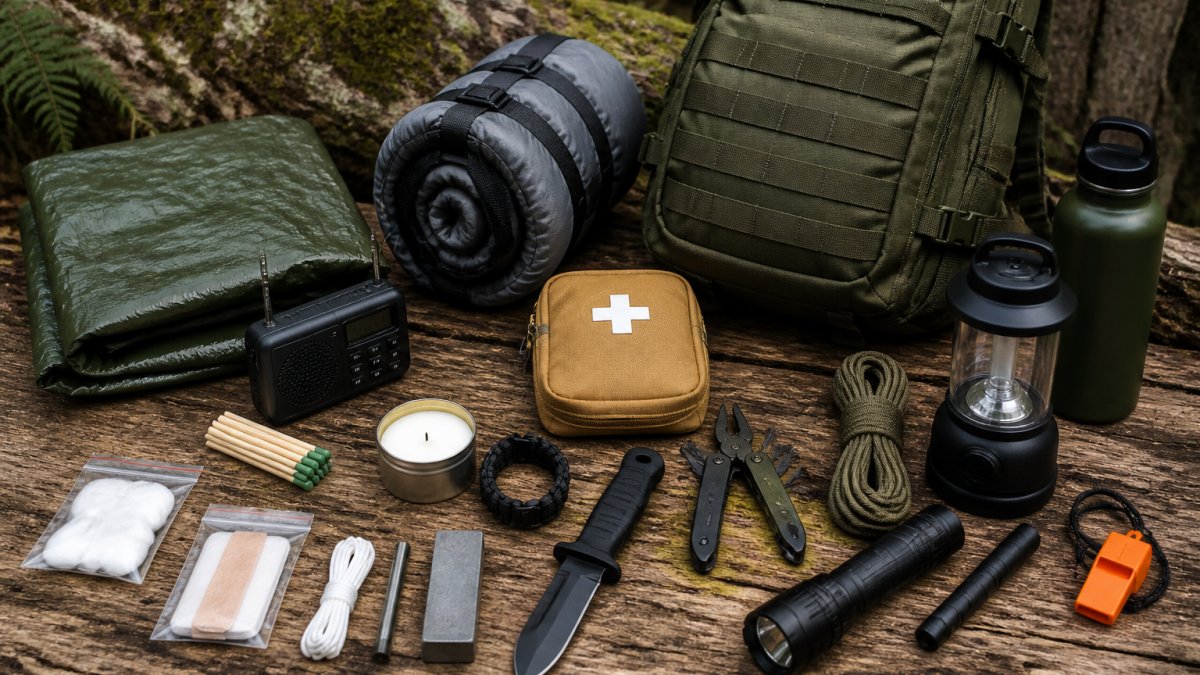
A survival kit is a curated set of tools that keeps you warm, hydrated, found, and fed until help arrives or you walk out. The essentials fall into five groups: cutting tools, fire, shelter, water, and signaling.
Core Tools: Knives, Multi-Tools, and Saws
Your cutting tool is the backbone of any survival kit. A fixed-blade knife handles batoning and food prep, a multi-tool covers repairs, and a folding saw processes firewood faster than any knife.
- Fixed-blade knife: Full tang, 4 to 5 inch blade, no folding parts to fail
- Multi-tool: Pliers, screwdriver bits, and a can opener in one frame
- Folding saw: Cuts wrist-thick branches in seconds
- Small shovel or trowel: For catholes, fire pits, and snow
Fire-Starting Tools
Fire-starting is non-negotiable, so carry three ways to make a flame: a ferrocerium rod that works when wet, a butane lighter for speed, and waterproof matches as backup. Practice with each before you need it.
Shelter and Weather Protection
Emergency shelter means a layer between you and the weather, a tarp, an emergency bivy, or a lightweight tent, plus a way to stay dry. Pack a rain shell and an insulating layer even on clear forecasts: wet and windy at 50 degrees is more dangerous than dry and cold at 20.
72-Hour Emergency Kit Checklist for Home and Car
A 72-hour emergency kit checklist covers the three days it typically takes for organized help to reach you after a disaster. Keep one at home and one in your vehicle as separate kits rather than splitting one supply.
- Water: one gallon per person per day, plus a personal water filter
- Food: three days of shelf-stable calories and a manual can opener
- First-aid kit with bandages, antiseptic, and any personal medications
- Flashlight or headlamp with spare batteries
The FEMA ready.gov emergency supply guidance recommends reviewing your kit annually and replacing expired food, water, and medications. That single habit keeps a kit usable instead of decorative.
Best Survival Kits: Pre-Assembled vs. Custom
The best survival kits match your actual scenario, not the biggest box on the shelf. Pre-assembled kits win on convenience and price; custom kits win on fit and quality.
| Approach | Best For | Main Advantage | Watch Out For |
|---|---|---|---|
| Pre-assembled kit | Beginners, car kits, gifts | Ready in one purchase | Filler items you will replace |
| Custom kit | Backpackers, preppers | Gear tuned to your climate | Higher upfront cost |
| Hybrid kit | Most households | Fast start, smart upgrades | Requires one planning session |
A practical middle path: buy a pre-assembled kit as your foundation, then upgrade the knife, headlamp, and water filter first. Those three swaps fix the weakest parts of most budget kits.
Top Survival Tools for Camping and Backpacking
Survival tools for camping and backpacking should earn their weight, because every ounce you carry is an ounce you haul up the trail. Prioritize multi-use items and leave single-purpose gadgets at home.
The honest answer to "what should I carry" is: it depends on the scenario. A day hike and a multi-day wilderness trip are different problems, as are cold-weather and desert trips.
Scenario-Based Kits
Home power outage (72 hours, no travel). Weight is irrelevant, so comfort matters.
Day hike (6 to 10 hours, close to help). The Ten Essentials framework is the right baseline: navigation, sun protection, insulation, illumination, first aid, fire, repair tools, nutrition, hydration, and emergency shelter (Ten Essentials (U.S. National Park Service)).
Evacuation (leave home fast, unknown duration). This is where a pre-packed go-bag earns its keep. Documents, medications, cash in small bills, a change of clothes, and a charged power bank matter as much as tools.
Multi-day wilderness trip (self-rescue likely). You are the rescue team.
How Climate Changes the List
- Cold: Insulation and fire move to the top. Add a metal water bottle you can boil in, hand warmers, and a sleeping pad with a higher R-value. Batteries lose capacity in the cold, so keep spares in an inside pocket.
- Hot and arid: Water capacity and sun protection dominate. Carry more water than you think you need, add electrolyte tablets, and choose light-colored, loose clothing. A shade tarp can be more valuable than a sleeping bag.
- Wet: Waterproofing beats warmth. A tarp, a dry bag for your fire kit, and a ferrocerium rod that strikes when wet matter more than a fancy lighter. Assume everything you set down will get soaked.
- Urban: The threats shift to infrastructure failure, not wilderness exposure. A flashlight, a dust mask, sturdy shoes, and a paper map of your metro area are more useful than a bushcraft knife.
How Skill Level Changes the List
Gear you cannot use is weight you should not carry. Match the kit to the skill.
- Beginner: Choose gear with one obvious function and practice it before you need it. A push-button headlamp beats a multi-mode light with a hidden menu. A squeeze filter beats a pump you have never primed.
- Intermediate: Add redundancy and a second ignition method. Learn to read a map and compass together, not separately.
- Advanced: Carry fewer, more capable tools and trust your skills to fill the gaps. A single well-maintained knife and a ferro rod can replace a pouch of gadgets.
The Core Tool List
Whatever the scenario, these categories stay constant. Only the specific item changes.
- Cutting: Knife, multi-tool, folding saw
- Fire: Ferro rod, lighter, waterproof matches
- Water: Personal water filter, treatment tablets
- Light: Headlamp, backup flashlight
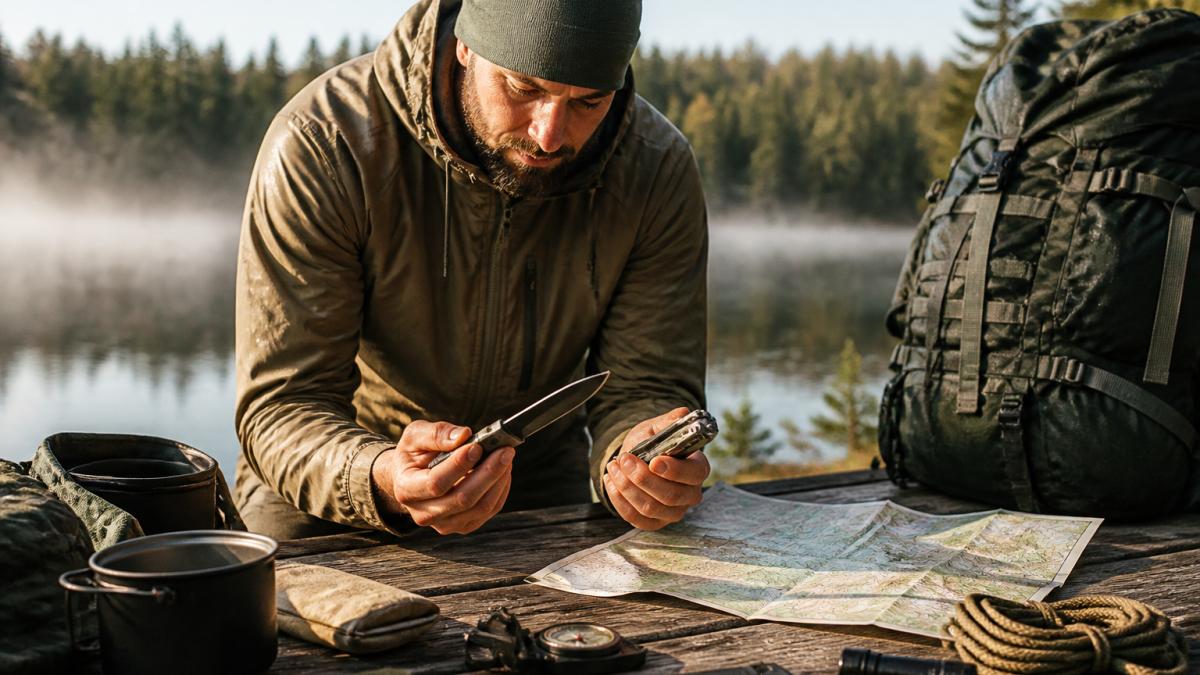
Navigation deserves special attention. A compass and paper map keep working when your phone dies, and pairing them with a whistle covers the two most common backcountry emergencies: getting lost and getting hurt.
The National Park Service trip planning resources consistently stress leaving a trip plan with someone at home. A plan costs nothing and is often the fastest route to rescue.
Maintenance and Replacement Schedule for Survival Equipment
Maintenance separates a kit that works from one that only looks ready. Inspect your gear twice a year and replace consumables on a schedule rather than waiting for failure.
| Item | Check Frequency | Replace When |
|---|---|---|
| Water filter | Every trip | Flow slows or after storage freeze |
| Batteries | Every 3 months | Any sign of corrosion or leakage |
| Food and water | Every 6 months | Past expiration date |
| First-aid supplies | Every 6 months | Expired or opened packaging |
| Ferro rod and matches | Every 6 months | Rod worn thin, matches damp |
| Knife and multi-tool | Every trip | Blade chips or pivot loosens |
Sharpen blades after every few uses, store batteries outside the device, and keep water containers out of direct sun.
The gap between a kit that sits in a closet and one that saves a trip comes down to fit, quality, and upkeep.
Frequently Asked Questions
What survival equipment should everyone have?
Everyone should carry the 10 essentials: navigation (map, compass), sun protection, insulation, illumination, first-aid supplies, fire-starting tools, repair kit, nutrition, hydration, and emergency shelter. For urban or car kits, add a whistle, multi-tool, and spare batteries. Focus on items that address core needs: warmth, water, food, and signaling. Avoid overpacking; prioritize versatility and reliability.
How much water should you store for an emergency?
Store at least one gallon per person per day for a minimum of three days. For a 72-hour emergency kit, that's three gallons per person. Include water treatment supplies like filters or purification tablets in case you need to use natural sources. Rotate stored water every six months and check expiration dates on treatment options.
What should be in a basic survival kit?
A basic survival kit includes a fixed-blade knife, fire starter, emergency shelter (tent or bivy), water filter, first-aid supplies, flashlight or headlamp, compass, map, whistle, and high-energy food. For camping, add a multi-tool and saw. Pack items in a waterproof container. Customize based on your environment and skill level.
How often should you check and replace survival kit supplies?
Inspect your kit every six months. Replace expired food, water, and medications. Test flashlights, fire starters, and water filters. Check batteries and rotate them annually. For items like knives and multi-tools, clean and lubricate as needed. Replace worn or damaged gear immediately. Keep a checklist to track expiration dates and maintenance tasks.