 Ultimate guide
Durable Survival Gear for Long Trips: The Essential Guide
Last Updated: November 19, 2026
Quick Summary
Durable survival gear for long trips means tested, redundant tools that survive field conditions and can be repaired without a workshop. Build your kit around function rather than a preassembled box, adding one primary and one backup for every life-sustaining function.
- Weekend kits optimize for lightness and cost, while long-trip kits optimize for redundancy and repairability.
- For multi-day travel, look at packs in the 50 to 80 liter range for loads of 30 to 50 pounds.
- Carry two water treatment methods so a clogged or frozen filter does not leave you without safe water.
- Plan food by resupply interval, commonly every 5 to 7 days, rather than by total trip length.
- Score repairability before buying: a slightly heavier item you can fix beats a lighter one you cannot.
Table of Contents
- Why Durable Survival Gear for Long Trips Differs from Weekend Kits
- The Survival Gear List: Eight Categories That Matter Most
- Building a Long-Trip Survival Kit That Holds Up
- Extended Wilderness Trip Gear: Weight, Volume, and Load Planning
- How to Judge Durability Before You Buy
- Maintenance and Field Repair on the Trail
- Matching Gear to Climate and Terrain
- Choosing Your Extended-Trip Loadout at Camp Cave Forest Supply
- Frequently Asked Questions
Why Durable Survival Gear for Long Trips Differs from Weekend Kits
The gear that gets you through a weekend car camp is not the gear that gets you through a ten-day backcountry traverse.
It does not work. Weekend kits optimize for lightness and cost. Long-trip kits optimize for redundancy, repairability, and the ability to keep functioning after days of abuse. A zipper that fails on night two is an inconvenience.
The Ten Essentials framework from Public Lands is a useful starting point, but it assumes a day hike or short outing. Extended wilderness trip gear has to answer harder questions: what breaks first, what can you fix in the field, and what happens when the weather turns for four straight days.
The Survival Gear List: Eight Categories That Matter Most
Any credible survival gear list for extended trips covers eight functional categories. Skip one and you are gambling on conditions staying friendly. The categories are backpacks and carrying systems, water storage and purification, shelter, fire-starting tools, cutting tools, first aid, navigation, and emergency food and layers.
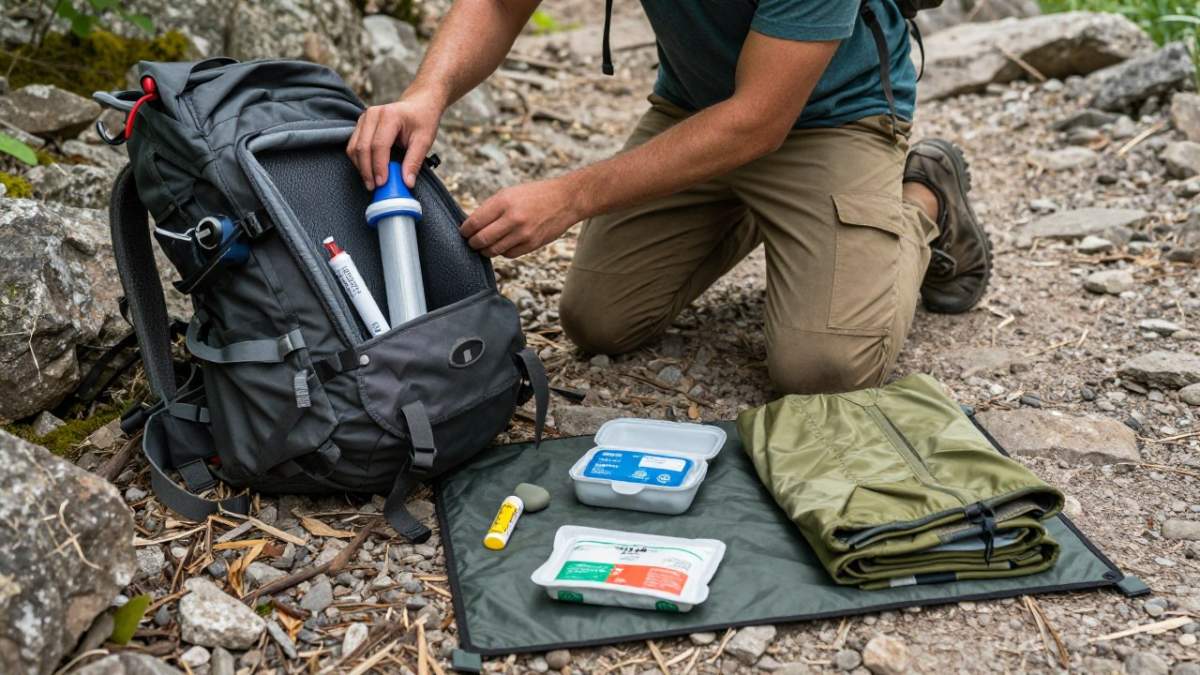
Backpacks and Carrying Systems
For multi-day travel, look at packs in the 50 to 80 liter range, sized for loads that typically run 30 to 50 pounds according to OutdoorGearLab's backpacking pack guidance. The frame and hip belt matter more than the fabric. A pack that transfers weight poorly will wear you down by day three regardless of how durable the material is.
Water Storage, Filtration, and Purification
Carry two methods, not one. A filter handles sediment and pathogens; purification tablets or a backup chemical treatment cover you when the filter clogs or freezes. Stainless steel canteens survive drops that crack plastic bottles, and a wide-mouth opening makes field cleaning practical.
Shelter, Bivvies, and Emergency Blankets
Your shelter is a system, not a single item. A tent or tarp handles planned nights; a bivvy and an emergency blanket handle the unplanned ones. If you are weighing shelter options, you can browse a two-person waterproof tube tent as a lightweight backup layer.
Fire-Starting Tools, Cutting Tools, and First Aid
Redundancy is the rule here. Carry matches, a ferro rod, and dry tinder in separate places. For fire, a durable ferro rod fire starter will outlast matches in wet conditions. For medical coverage, a tactical medical kit gives you organized access to supplies when hands are cold and light is low.
Building a Long-Trip Survival Kit That Holds Up
A long-trip survival kit is a set of tested, redundant tools that survive field conditions and can be repaired without a workshop. Build it around function, not around a preassembled box.
Here is where we part ways with the big-kit approach. Outdoor Life's survival kit review notes that most survival kits are not worth carrying in the field, even among kits vetted by an instructor.
Build your kit in this order:
- Define your longest plausible self-rescue window
- Add one primary and one backup for every life-sustaining function
- Weigh the full kit and cut anything without a clear job
- Test every item at home before it goes in the pack
- Repack after each trip and replace anything that showed wear
Extended Wilderness Trip Gear: Weight, Volume, and Load Planning
Weight planning is the difference between a hard trip and a miserable one, but the planning changes with trip length. A three-day loadout and a three-week loadout are not the same kit scaled up. The useful approach is to set a base-weight target, plan resupply intervals, and decide redundancy per function rather than per item.
Set a base weight by trip length
Base weight is everything you carry minus food, water, and fuel. Most long-trip planners work in three tiers:
| Trip length | Typical base weight target | What changes |
|---|---|---|
| 3-5 days | 12-18 lb | Single treatment method acceptable; minimal repair kit |
| 6-14 days | 15-22 lb | Two water methods; fuller repair kit; shelter redundancy |
| 15+ days | 18-25 lb | Resupply plan drives everything; repairability over lightness |
These are planning ranges, not rules. The point is to measure your base weight before each trip so you can predict how the pack will carry once food and water are added. A pack that feels fine at 25 lb total can become punishing at 40 lb, and the difference is usually food and water volume, not gear.
Plan water by consumption and treatment capacity
Water is the heaviest consumable and the one most often under-planned. Carry capacity for the longest dry stretch between sources, not the average. Two treatment methods, a filter plus chemical tablets or a backup filter, cover the case where the primary clogs or freezes. On long trips, treatment capacity matters as much as storage: a filter rated for a limited volume will need backflushing or replacement, so check the manufacturer's rated liters and carry a spare cartridge or a chemical backup.
Plan food by resupply interval, not by day
Food volume drives pack size on trips longer than a week. Plan calories per day, then pack by resupply interval rather than by total trip length. A common pattern is to plan resupply every 5 to 7 days, which keeps food weight manageable and forces you to test your resupply logistics before the trip.
Balance redundancy against load
Redundancy is not free. One backup per critical function, water treatment, fire, shelter, navigation, is the standard. Two backups per function is usually overpacking. The trade-off is explicit: every backup adds weight and volume, so decide which functions can fail without ending the trip. Navigation and water treatment are usually worth a backup; a second stove often is not.
Use load-hauling tools only when the plan demands it
For very large loads, some long-trip planners use an expedition canoe or pack raft to move equipment, as Survival Skills Guide suggests.
Watch out: packing food by total trip length instead of by resupply interval is the most common cause of an overloaded pack on day one of a long trip.
How to Judge Durability Before You Buy
Durability is testable, not a marketing claim. The problem is that most gear listings give you a fabric name and a weight in denier, then stop. For a long trip, you need to translate construction details into expected service life and field repairability. Here is how to do that before you spend money.
Read the construction, not the badge
Start with the places gear actually fails: seams, attachment points, and closures. Double stitching at stress points and bar tacks where straps meet fabric are the minimum.
Hardware is the next filter. Metal buckles and zipper pulls survive cold better than plastic, which gets brittle below freezing. Zippers are the most common field failure on shelters and packs; a #8 or #10 coil zipper with a metal slider is more serviceable than a molded plastic zipper that cannot be repaired without a specialist.
Translate fabric weight into abrasion resistance
Denier is a measure of yarn thickness, not a guarantee. A 210D nylon pack body resists abrasion better than a 70D ultralight fabric, but it also weighs more and packs larger. Heavier pack fabrics generally resist abrasion better than ultralight fabrics, though they also weigh more and pack larger. Ask what the fabric is coated with, polyurethane coatings are common, but silicone-impregnated fabrics shed water without a coating that can peel.
Ask about service life in trips, not years
A manufacturer's "lifetime" claim is not a durability spec. A more useful question is how many nights or trail miles the item is expected to deliver under regular use. Service life for shelters and packs varies widely with use, so inspect them regularly and plan repairs or replacements ahead of long trips.
Score repairability before you buy
This is the question most guides skip. A slightly heavier item you can fix beats a lighter one you cannot. Score each candidate on four points:
- Field-fastenable: Can the failure be fixed with cord, tape, or a patch? A torn stuff sack yes; a delaminated waterproof membrane no.
- Replaceable parts: Are buckles, zipper sliders, and pole sections sold separately?
- Tool requirements: Does repair need a sewing machine, or just a needle and floss?
Watch out: a waterproof-breathable jacket with a delaminated membrane cannot be field-repaired and will not regain waterproofness with tape, so treat it as a consumable on very long trips rather than a durable item.
Test at home before the trail
You can approximate field wear without a lab. Load the pack to its expected trip weight and carry it for a few hours on a local trail; check for hot spots at the hip belt and shoulder straps. Set up the shelter in wind and rain, then inspect the seams.
Maintenance and Field Repair on the Trail
A common mistake is treating maintenance as an afterthought.
Before each trip, inspect seams, zippers, and straps. Carry a small repair kit: cord, tape, a needle, and spare buckles. Dry everything thoroughly after use.
Watch out: storing a wet shelter compressed in a pack for weeks will grow mildew that permanently damages the fabric.
Matching Gear to Climate and Terrain
Climate changes the gear list more than any other variable. Wet climates demand better waterproofing and more fire redundancy. Cold climates demand insulation that still works when damp.
Terrain matters too. Rocky ground eats through thin shelter floors; dense brush shreds lightweight fabrics. Match fabric weight and shelter style to the ground you will actually sleep on.
Choosing Your Extended-Trip Loadout at Camp Cave Forest Supply
Building a loadout is easier when the catalog is curated rather than endless. If you are still comparing options, our essential gear guide walks through the broader equipment picture. You can also read what makes a reliable wilderness survival kit worth buying before you commit.
Long trips punish gear that was never built for them. The fix is not more equipment, it is better-chosen equipment with redundancy and repairability built in.
Frequently Asked Questions
How do I choose durable survival gear for a long trip?
Start with the load you can actually carry, and choose a pack sized to your trip. Then screen every item for construction, not marketing. Look for reinforced stitching, metal hardware instead of plastic, and serviceable parts you can repair in the field. Pick gear that serves more than one job, and test each piece on a shorter trip before you trust it on an extended one.
What should I pack in a survival kit for an extended wilderness trip?
Build around functional categories rather than one preassembled box. A working kit typically covers tools, shelter, fire starters, and medical supplies, along with navigation, light, food, water, and extra layers. For a long trip, add repair materials, a backup water treatment method, and enough food and fuel to cover a delayed resupply.
How much survival gear should I carry for a multi-day trip?
Carry what you can move with comfortably for a full day, then plan resupply around that limit. Multi-day packs are often sized to the load you plan to carry. Weigh your full kit before you leave and treat that number as a ceiling, not a target. Every item should earn its place through function or backup value, and bulky duplicates are the first thing to cut.
Is a large preassembled survival kit worth carrying?
Often not in the field. Outdoor Life reports that most survival kits are not worth carrying, though its evaluation criteria are not published. The practical takeaway is to assemble your own kit from gear you have tested, sized to your trip and climate. A preassembled kit can work as a home or vehicle backup, but for an extended wilderness trip, a self-built kit of durable, multi-use items is more reliable.
How can I maintain survival gear during a long trip?
Set a daily routine: dry anything that got wet, check water treatment and fire starters, and inspect straps and seams for wear. Carry a small repair kit with cord, tape, and a needle, and fix small failures before they become trip-ending ones. At resupply points, clean and lubricate cutting tools, restock first aid, and replace used tinder. Gear that is checked daily lasts measurably longer than gear that is only inspected when it breaks.
How long can emergency food and stored supplies last?
Shelf life depends on the product and storage conditions. Shelf life depends on the product and storage conditions, so check manufacturer labeling for specifics. Treat long shelf-life claims as a starting point: store supplies cool and dry, rotate them on a schedule, and check packaging for damage before relying on it for a long trip.